Dandyland
gathering the garden…
Dandyland
gathering the garden…
An intimate portrait
Born in 1959 near Somerset, Kentucky, on a 200-year-old family farm. Painter, composer, singer, sculptor, theater director, designer, filmmaker — not separate careers, but one imaginative practice wearing many coats.
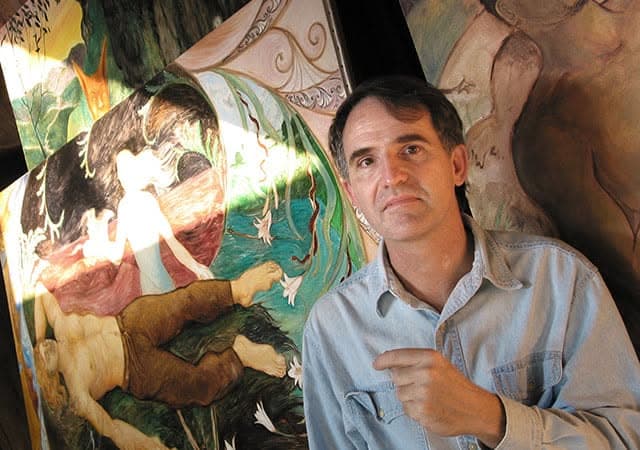
The first piece was a muffin tin, beaten flat with a hammer in the yard when he was five or six — keeping sharp time, he recalls, with a secret droning melody held in the hills. He was painting by three, singing before he could remember not singing, selling paintings at fourteen, and living from his art out of his own studio by seventeen. He never had a formal art lesson.
What followed refuses a single category: video installations commissioned by the Speed Art Museum; a one-man show in the rotunda of the US Congressional Office Building; nine operas, beginning with The Stone Man, premiered by Kentucky Opera in 1990; the four-part dance-opera cycle The Secret Commonwealth, broadcast by KET and nominated for an Emmy; twelve monumental ballad paintings for 21c Museum; ceramics for Rookwood; and a sculpture studio in the old carriage house.
All of it comes from one place — the farm outside Somerset he half-jokingly named Dandyland, where the Duttons have lived since before the Civil War crossed their hill.
1959
Born near Somerset, Kentucky, on a 200-year-old family farm — land the Dutton family has held since before the Civil War Battle of Dutton Hill was fought on it.
1962
Begins painting at age three. The songs come at five or six — beating a muffin tin flat with a hammer in the yard, keeping time with a melody only he could hear.
c. 1973
Sells his first paintings at fourteen. At fifteen, hears Jean Ritchie sing at the first Berea Craft Fair and is, in his word, awestruck.
c. 1976
Builds his first studio at seventeen and begins making a living from his art, on his own terms.
1980s
Shows visual and video installation art at the J.B. Speed Art Museum in Louisville, which commissions two video works: A Day in the Life of the Artist and Water, an installed environment.
1984
Paints Tobacco — the last crop of tobacco raised on the family farm — and Death of a Ballad Singer, after the passing of his mentor Chappel Wallin.
1985
A one-man show fills the rotunda of the US Congressional Office Building in Washington.
1990
The Stone Man — the first of nine operas, composed at twenty-nine — premieres with Kentucky Opera at the Kentucky Center for the Arts, then tours the state.
1995–2000
The Secret Commonwealth, a four-part cycle of dance operas, is staged across Kentucky. The first three parts are filmed and broadcast by Kentucky Educational Television; part one is nominated for an Emmy, and KET's films are still used in Kentucky's public schools.
1997
Travels to Japan, playing old Appalachian ballads on dulcimer and guitar for Japanese audiences. Long study of the sacred tea ceremony follows him home into the moss gardens at Dandyland.
2003
21c Museum Hotels commissions twelve scenes from traditional ballads — the seed of Ballads of the Barefoot Mind.
2006
Ballads of the Barefoot Mind opens at 21c Museum, Louisville: twelve monumental oils in carved and painted frames, twelve ink-and-watercolors, and new recordings of the ballads, performed live through the opening weekend.
A season away
Artist in residence for Rookwood Pottery, creating a new line of ceramics as they brought their work back to market.
2016
The sculpture studio is founded in the 200-year-old carriage house — metalwork alongside the painting. Its bronze turtles now line Turtle Bale Spring at Alys Beach, Florida.
Now
Lives and works at Dandyland, Somerset — the last of the Duttons still on the land, his studio a quarter mile from the Dutton's Hill monument — raising a new 40-by-80-foot studio with sixteen-foot ceilings.
Farming
“Both of my parents were farmers. They were devoted to the land, but, and maybe because of this, they appreciated beauty and art.”
Ballads
“As a child, I remember my parents and older people in my community singing these songs. I can remember closing my eyes and listening to them, and I'd see the story like a film.”
On the murder ballads of Kentucky
Nature
“I studied the natural sciences nearly as closely as I do the arts. The two are inherently connected, and all created, visual imagery ultimately springs from the natural world.”
Tradition
“My feeling for the ballads was and is that they must incorporate and process every cultural change in order to truly live on.”
On learning from Jean Ritchie — and departing from her
Making
“I cover the canvas with a coat of reddish brown, draw with dark brown, then develop the contours with white and monochrome browns until it's like a sepia photo. The colors are then laid on in transparent layers.”
On how the ballad paintings are built
Memory
“Tape recorders can produce ghosts, and maybe that's the best thing they are able to do.”
Whimsy
“I am the king of whimsy!”
When asked if the Alys Beach turtles could be a bit more whimsical
Folks
“Either we're all folks or none of us are.”
On the label “folk music”
— Dan Dutton, from interviews
Institutions and public places where the work lives.